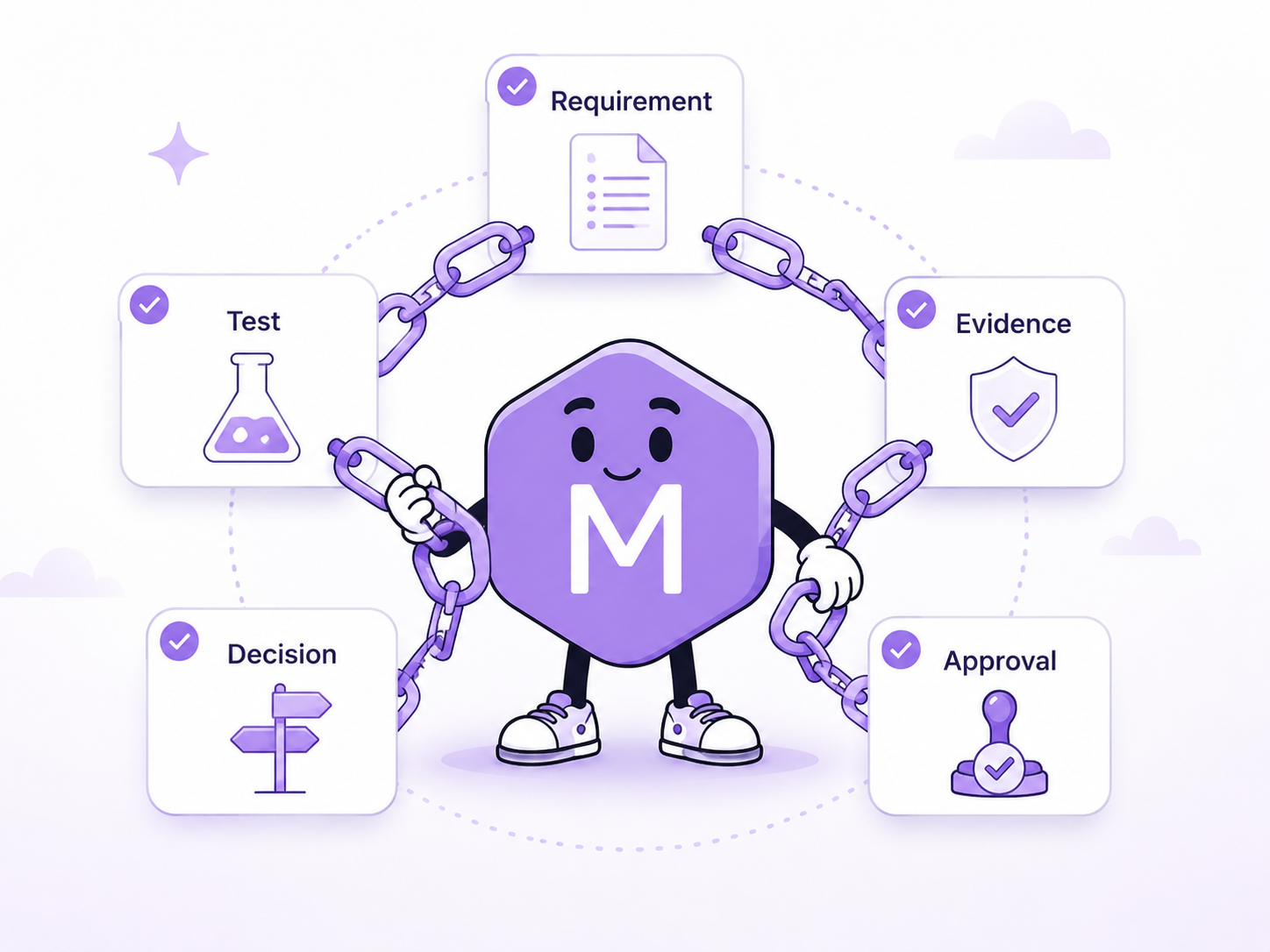
CONTINOUS DEVELOPMENT MADE EASY

Connected productivity tools and governed systems.

Enterprise software specialized the application. M Theory specializes the capability. Sheet, Doc, Canvas, Deck and Plan are views over one governed Work Graph — structure, traceability, versioning and approvals sit underneath the surfaces people already use, so you do the work, and the evidence follows.

The M Theory Office workspace: ribbon, project explorer, connected records and inspector

Every company building complex products ends up with a Frankenstack.

Work fragments across Excel, Word, PowerPoint, Jira, requirements tools, MBSE tools, test systems, QMS software and dozens of specialized applications. Then every design review, assessment, audit, safety case or certification cycle forces teams to export that information back into Office, clean it up, reconstruct traceability, collect comments and manually reconcile everything into the source tools.

  • Export-and-reentry between tools that never agree
  • Traceability maintained by hand, in a spreadsheet
  • Impact analysis performed in review meetings
  • Evidence assembled the month before the assessment

Productivity tools

Flexible but weakly governed

ExcelWordPowerPointJiraEmailSlides in a shared drive

Enterprise systems

Governed but specialized

DOORSRV&S / CodebeamerMBSE toolsTest systemsQMSPLM

M Theory

Flexible and governed, in one environment

The answer to document-centric work isn’t eliminating documents. It’s separating the document interface from the underlying work model.

The inversion

Enterprise software specialized the application. M Theory specializes the capability.

Strip away the branding and most of these systems reduce to the same primitives — text, tables, forms, diagrams, relationships and workflow — plus governance. The specialized value was never the editor. It was schemas, stable IDs, typed relationships, validation, approvals, baselines, audit history and traceability.

Surfaces

Sheet · Doc · Canvas · Deck · Plan

The interfaces people already know how to use.

Work Graph

Objects · stable IDs · typed relationships · history

One governed model beneath every surface.

Governance · Automation · AI

Permissions · reviews · baselines · rules · agents

The capabilities every specialized tool rebuilds from scratch.

Packs

Requirements · FMEA · ASPICE · Safety · Quality · Legal · MBSE

Domain semantics, rules and workflow — configuration, not a new product.

Historically, app = UI + database + workflow + domain model

  • Its own database
  • Its own UI and workflow
  • Its own permissions and versioning
  • Its own reporting and API
  • Its own integration layer

In M Theory

  • Platform — objects, governance, relationships, computation
  • App — a view over the objects
  • Pack — domain semantics, rules and workflow

The irreducible complexity of requirements, safety, compliance and configuration belongs in the platform — carried once, instead of imposed on every user through a different application.

One object. Five representations.

A requirement is an object: ID, text, owner, status, rationale, source, revision, verification method, relations, evidence, history. There is no reason that object must live inside a bespoke requirements editor.

Sheet

REQ-104 · Approved · verified by TEST-23

A row with identity, owner and revision history.

Doc

REQ-104 — The system shall release the brake within 500 ms.

A controlled paragraph, not formatted text.

Canvas

REQ-104 → allocated-to → Brake Controller

A connector is a traceable interface.

Deck

93% of safety requirements verified

A statistic read live from the graph.

Plan

Gate 3 · evidence for REQ-104 outstanding

A milestone that knows what it is waiting on.

Same governed truth. Different views. The hazard analyst can work in Sheet, the assurance engineer in Canvas, the reviewer in Doc and the executive in Deck — without anyone exporting anything.

Five surfaces. One governed Work Graph.

People keep working in familiar documents, spreadsheets, diagrams, decks and plans. Underneath, structure, traceability, versioning, approvals, baselines, auditability and domain logic are already in place. Specialize the capability, not the user experience.

SheetEvery row is an object with identity, owner and version history.
DocSections and phrases carry provenance, review state and approvals.
CanvasA connector is a traceable interface, not a line on a page.
DeckSlides read from the record, so a review deck is never out of date.
PlanGates and milestones collect evidence as the work progresses.

What it looks like in the work.

Not a dashboard bolted on top. The governance is inside the documents, sheets and decks people already produce.

Traceability view showing a hazard linked to its element, failure modes, bench test and run

One hazard, the whole chain

Open any record and see what it comes from and what depends on it — safety goal, allocated element, failure modes, verification and the run that produced the evidence. Stale and failed states surface inline.

Domains arrive as Packs, not as separate products.

A Pack adds schemas, rules, terminology and workflow. Everything else it inherits from the platform. A team that would otherwise build an ISO 26262 SaaS product builds an ISO 26262 Pack instead — and ships only their actual domain expertise.

RequirementsTyped requirement objects, verification methods, coverage.
FMEAFailure modes, RPN/AP calculation, action tracking.
ComplianceRegulation clauses linked to evidence and approvals.
ASPICEProcess evidence collected from the work already performed.
SafetyHazards, ASIL logic, claims, arguments and assurance status.
QualityCAPA, APQP/PPAP, control plans and audits.
LegalControlled clauses, obligations and review workflow.
MBSESystem elements, allocations and interface control.
FinanceGoverned models with baselines and approval trails.

Every Pack inherits

Identity and permissionsCollaboration and commentsVersioning and baselinesAudit historySearch and reportingAI over the graph

What stays specialized

CAD, CAE, simulation engines, compilers, source control and ERP transaction processing have genuinely specialized interaction and computation needs. What collapses is structured knowledge work — the large middle category built out of text, tables, diagrams, relationships and workflow.

Change one requirement. See everything it touches.

Hover any link to see what a change there does to everything downstream — the same walk the workspace performs for real, the moment the edit is made.

Then generate the Excel matrix, the Word report or the PowerPoint review deck straight from the graph — no manual reconstruction, no reconciling it back afterwards.

The export loop is the market signal.

Specialized systems usually have the structure people need, but not the environment people want to work in. So every review cycle runs the same loop by hand.

  1. Specialized system
  2. Export
  3. Excel / Word / PowerPoint
  4. Clean, format, rearrange
  5. Collaborate and review
  6. Comments and findings
  7. Manual reconciliation
  8. Back into the system

Teams are already telling the market what they want: the governance of the specialized tool with the usability of general-purpose productivity software. M Theory removes the loop by making the productivity surface the governed system.

Why now.

Digital threads are being funded

Companies are hiring executives specifically to move from document-centric development to model-based continuous validation with end-to-end traceability. The architecture problem is already on someone's objectives.

AI makes fragmentation more expensive

An agent is only as good as the context it can reach. Twenty disconnected tools means twenty schemas, permission models and partial representations of reality.

The specialized app is no longer necessary

Structured objects, graph relationships, collaborative editors, programmable workflow and governance can now live beneath general-purpose interfaces.

See review readiness continuously, not at assessment time.

When an interface changes, M Theory traces the impact through the graph and works out what has been affected, what has gone stale, what must be reverified and which approvals need to be reopened — while the change is being made, in time for the next release or assessment decision.

12

Evidence gone stale

5

Awaiting reverification

3

Approvals reopened

Approvals queue bound to record revisions, with a recomputed hazard in the inspector
Approvals stay bound to the revision they were made against — change the source and the downstream approval is flagged, not inherited.
78%Programme readiness

Derived from live evidence — approvals, verification coverage and open impact — not from a status slide.

The thesis

Land in one workflow. Become the layer the work lives on.

Land

Reviews, assessments and compliance evidence

Connect

Requirements, architecture, risk and verification

Expand

Planning, quality, change and assurance

Platform

General-purpose and governed productivity, together

The full argument — the systems-engineering literature, signals from practice, what the assurance record shows about evidence going stale, the spend already committed, and what a governed Work Graph changes — is set out in the thesis.

Read the thesis

Flexible everyday work and governed enterprise work, in the same environment.

Built for 100–1,000-person automotive, aerospace, robotics, autonomy and defense teams moving from document-centric development toward MBSE, digital thread, continuous validation and formal compliance.